

Project Overview
As offshore wind power continues to expand along the French coastline, RTE has been tasked with ensuring reliable grid connection for a new generation of fixedbottom offshore wind farms, as well as a floating pilot wind project. These connections rely on complex networks of underground and submarine export cables, where operational reliability and early fault detection are critical.
To address these challenges, RTE has implemented advanced Distributed Temperature Sensing (DTS) for hotspot detection and Distributed Acoustic Sensing (DAS) for third party intrusion (TPI) and cable fault detection across its offshore links. These systems enable real-time monitoring and support improved operation and maintenance strategies.
Within this framework, AP Sensing has recently delivered monitoring solutions for a series of offshore wind projects, each with distinct technical requirements and deployment conditions.
This case study focuses on three of the latest completed projects, highlighting how tailored sensing solutions were applied to ensure performance, reliability, and long-term asset protection in demanding offshore environments.
The following three projects illustrate how these monitoring approaches were implemented across different cable configurations, voltage levels, and installation environments.
The Fécamp wind farm, located off the coast of Normandy in the English Channel, is connected through two 225 kV export cables combining 31 km of underground and 17 km of submarine sections. The monitoring solution includes a two-channel N4525A DTS system and also a two-channel N5125B DAS unit, ensuring full coverage of both export cables and enabling continuous thermal and acoustic monitoring along the entire route.
The Saint-Brieuc wind farm, also located in the English Channel off the coast of Brittany, is connected through two 225 kV export cables spanning 16 km underground and 34 km submarine. Similar to Fécamp, the monitoring system integrates a two-channel N4525A DTS and a two-channel N5125B DAS unit to ensure that each cable is independently and continuously monitored.
The Gruissan floating wind farm pilot project, situated in the Mediterranean Sea in southern France, involves a single 66 kV export cable, with 3 km underground and 24 km submarine. The system design includes one single-channel N4525A DTS unit for temperature monitoring and one single-channel N5225B DAS system for acoustic monitoring.

Across all three projects, the fiber optic cable (FOC) installation follows a consistent configuration, adapted to both onshore and offshore environments. All monitoring is performed using single-mode optical fibers.
On the underground sections of the cable routes, outside the electrical substations, the power cables are installed in ducts and, in some areas, embedded in concrete using either trefoil or flat arrangements.
The optical fibers used for monitoring are deployed in dedicated ducts located in close proximity to the power cables, with an approximate spacing of 40 mm, ensuring effective thermal and acoustic coupling. Onshore, the FOCs end at the power cable terminations (see Figure 1), where they are spliced to transit cables routed towards the monitoring racks within the substations.
On the submarine sections, the power cables are buried in the seabed along most of the route, with the exception of the transition area where the cables ascend toward the offshore substation. In these sections, the system consists of one or two three-core power cables incorporating an integrated optical fiber within the cable structure, positioned beneath the armor layer. At the offshore platforms, the FOCs are terminated using fiber pigtails.

All sensing instruments are installed onshore in standard 19” cabinets for each project, as shown in Figure 2. Each cabinet integrates a main server running the SmartVision software , which provides the operator interface for system visualization and enables the transmission of alarm data to RTE’s cloud-based monitoring platform.
The DAS solution is configured to monitor each power cable route in real time, visualize acoustic energy as a function of time and distance through waterfall plots, store measured data on internal disks and redundantly on Network-Attached Storage (NAS) units, and trigger alarms in the event of a potential threat. Detection of TPI events relies on the identification of repetitive, high-magnitude, low-frequency vibrations generated in the ground, whereas cable fault detection is based on capturing impulsive, broadband signals.
Depending on the fiber length, a pulse rate of 1 kHz or 2 kHz is configured for each project. For longrange monitoring, a spatial sampling of 10 m and a gauge length of 20 m are applied, while for the shortrange section, these values are set to 5 m and 10 m, respectively.
Similarly, the DTS solution is configured to monitor the temperature profile of the power cables, store the corresponding data on the server, transfer it to RTE’s cloud-based monitoring platform, and trigger alarms in case of detected hotspots. The measurement time is set to 30 minutes for all DTS instruments, while the sampling interval and spatial resolution are configured to 1 m and 2 m, respectively, for the short-range section, and 2 m and 4 m for long-range sections. To ensure measurement accuracy along the full cable length, the DTS traces are calibrated using different reference conditions depending on the installation environment. Onshore sections are calibrated using known reference temperatures, while offshore sections rely on publicly available seabed temperature data. Validation at the far end of the cable routes is performed using PT100 sensors installed at the offshore platforms.
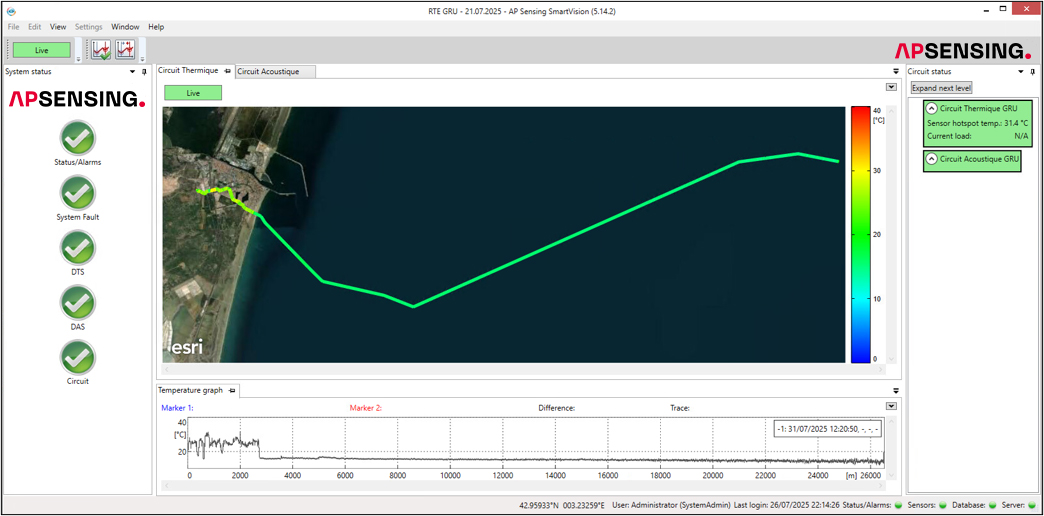
For both monitoring technologies, alarm notifications, including information on the type, time, and location of the event, are visualized in AP Sensing’s SmartVision platform (see Figure 3). In the event of TPI, cable faults, or fiber breaks, the location is highlighted, and a notification is generated containing the event type, timestamp, duration, fiber/asset position, GPS coordinates, and nearest landmark. These alarm notifications are also transmitted to RTE’s cloud-based monitoring platform for further processing.
Since commissioning, the DTS system has already demonstrated its value in early anomaly detection, as illustrated in Figure 4. In one instance, a localized temperature increase of approximately 7.4 °C was observed over a period of several weeks, corresponding to a gradual rise of about 0.35 °C per day. This deviation from the expected thermal behavior led to the identification of a potential hotspot, which was reported to the operator. Follow-up investigation confirmed that the temperature increase was caused by an accumulation of manure above the cable route. The manure pile generated and retained heat, resulting in the localized temperature increase detected by the DTS system. Appropriate measures were taken by the operator to mitigate the risk and prevent similar occurrences in the future.


The DAS system has also demonstrated its value in detecting and contextualizing external activities along the cable route (see Figure 5). In one project, acoustic signals associated with nearby construction works were identified and localized in real time. Thesenevents were subsequently verified and confirmed bynthe operator as planned activities in the vicinity of the cable infrastructure. This example highlights the capability of DAS to provide continuous situational awareness, enabling the differentiation between benign external activities and potential threats, while supporting informed decision-making without the need for immediate field inspection.
An additional feature of the DTS system is the Depth of Burial State (DoBS) assessment for submarine power cables. This method is based on the correlation between cable load and the resulting temperature response along the fiber. When the cable is buried, the heat dissipated during operation is retained in the surrounding soil, leading to a temperature profile that closely follows load variations. In contrast, when the cable is exposed, heat is more efficiently dissipated into the surrounding water, resulting in a weaker temperature response to load changes, as illustrated in the left chart of Figure 6.

By evaluating this load–temperature correlation – referred to as the thermal response – the system can identify sections where the cable may be insufficiently buried or exposed. A reduction in thermal response indicates potential exposure, as shown in the right chart of Figure 6. In such cases, the Depth of Burial State is flagged accordingly in the SmartVision platform.

Conclusion
The implementation of AP Sensing’s DTS and DAS across Fécamp, Saint-Brieuc, and Gruissan offshore wind projects demonstrates the effectiveness of fiber optic monitoring in ensuring the reliability of critical power cable infrastructure. By combining real-time hotspot detection, TPI monitoring, and advanced analytics such as DoBS assessment, the solutions provide continuous visibility along the entire cable route.
The results highlight how integrated DTS and DAS systems support proactive operation and maintenance, reduce operational risks, and enable informed decision-making. As offshore wind development continues to expand, such monitoring technologies play a key role in safeguarding assets and ensuring longterm performance of grid connections in challenging environments.

