

Fiber optic sensor cables are the key enabler for real-time monitoring of temperature, strain, and acoustic signals across diverse and challenging environments. Depending on the application and the used technology standard fiber optic telecom cables are suitable, while other applications may require specialty cables. These specialty sensor cables are designed to deliver precise measurements, even in harsh conditions.
How the Technology Works
Optical fibers consist typically of three main components: the core, the cladding, and the coating. The core and cladding have different refractive indices, which affect how light travels through the fiber. By utilizing total internal reflection, light can travel long distances with minimal signal loss. The core's refractive index is higher than that of the cladding, allowing light to be contained within the core and propagate over kilometers with minimal attenuation.
To protect and strengthen the core and cladding, a primary coating is applied. The choice of coating depends on the temperature range and sensing technology. For standard temperatures, polyacrylate coatings are used, while polyimide or metal coatings are suitable for high-temperature or cryogenic environments.
Primary coating ambient temperature range
| Primary Coating | Ambient Temperature Range |
| Acrylate | -40 °C to +90 °C |
| High temperature acrylate | -40 °C to +150 °C |
| Silicone PFA | -40 °C to +200 °C |
| Polyimide | -180 °C to 300 °C |
| Metal | >300 °C up to +500 °C |
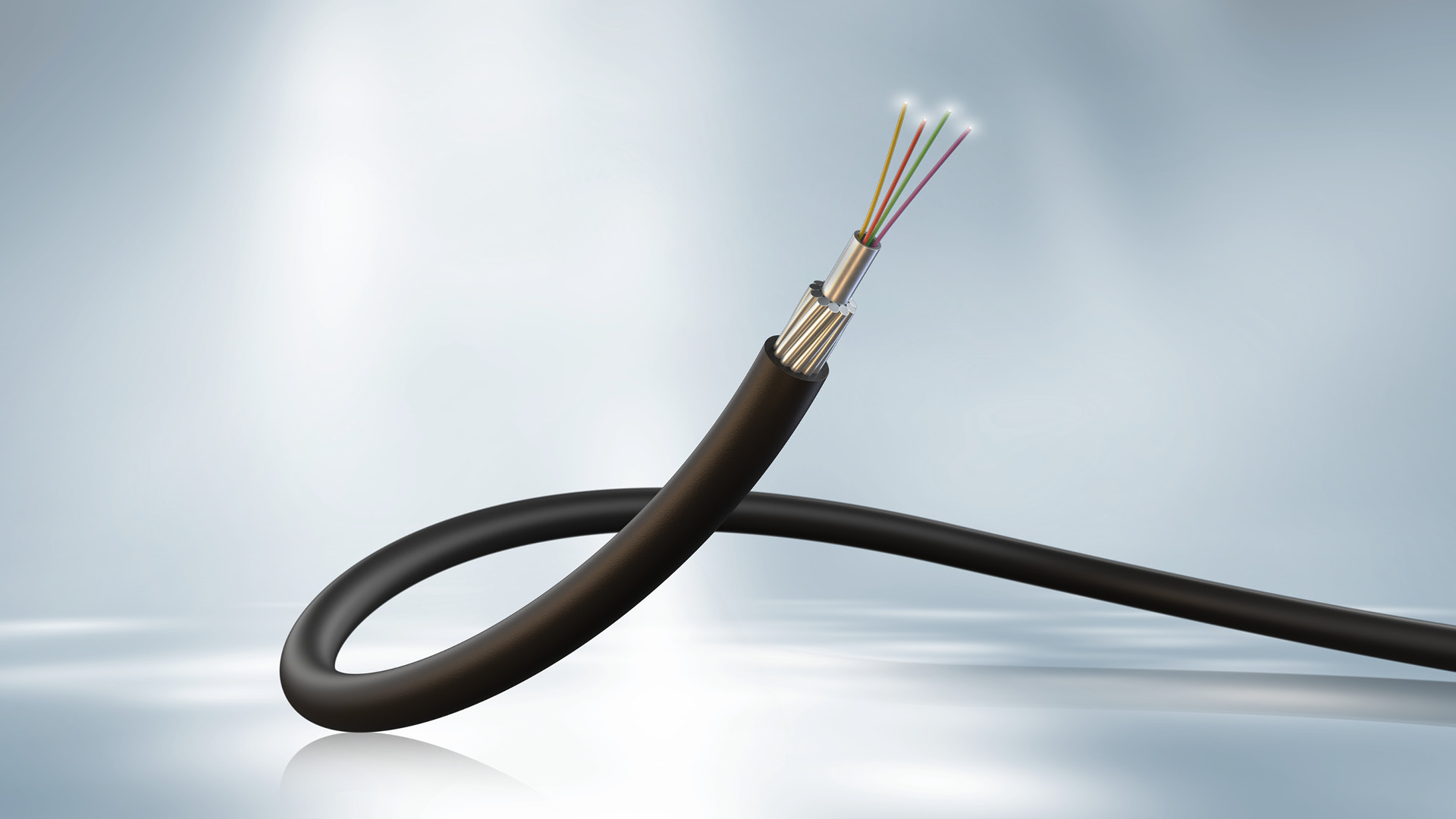
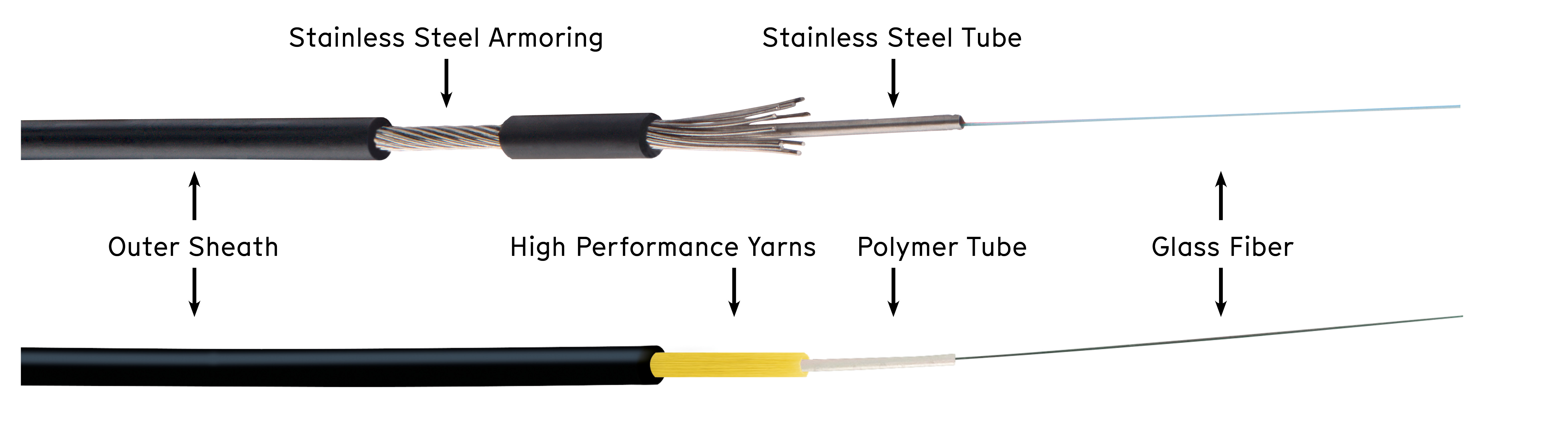
AP Sensing's sensor cables include the sensing fiber and come in various configurations, including metal-tubing, metal-free, tube-in-tube, and armored stainless steel. Metal-free cables are flexible and reduce the risk of induced voltages, while metal armored cables offer robust protection against harsh environments and rodent damage. We also provide different sheathings, such as flame-retardant non-corrosive (FRNC) and water-tight high-density polyethylene (HDPE), to meet specific environmental requirements.
Sensor cables are available with multimode (MM) and singlemode (SM) fibers or a combination of both. For MM fibers, typically a core of 50 µm or 62.5 µm diameter is chosen, which enables significantly more light to travel in the core than in SM fibers. Nowadays, a 50 µm core is preferred over 62.5 µm in most cases and has become the established standard for multimode fibers. Most MM fibers also have a graded index (GI) of their cross-section to reduce mode-dispersion. This means that the transition in index of refraction is gradual between the cladding and the core, as opposed to step-index fibers, where the refractive index sharply decreases from the core to the cladding (mostly used for singlemode fibers).

The main mode of light propagation is along the central fiber axis when an initial pulse of laser light is emitted into an optical fiber. If light enters the fiber at an angle to its centerline, this results in internal reflections causing the light to travel in the step-index (zigzag or spiral path) through the fiber.

The optical path of some light rays will be longer than others and will arrive after the main mode light. Due to the lower index of refraction near the edge of the fiber, the GI of MM fibers allows non-main modes of light to travel faster. This minimizes the effect of modal dispersion.

Typically, MM fibers are used for DTS and for most high-bandwidth fiber optic communication links. MM fibers have substantially greater cross-sections that enable much more light (more energy), that are coupled into the core. Furthermore and compared to the core of a SM fiber, MM fiber minimizes the core alignment mismatch, so less light gets lost at splices and mechanical connectors. All this results in a better signal-to-noise ratio (SNR) and resolution performance for DTS systems.
However, SM fibers are advantageous for different systems. The SM fibers typically have a small core of 9 µm in diameter. By allowing light to propagate in only one mode, modal dispersion is minimized. Less light can be coupled into the fiber, so obtaining measurements from the Raman scattering signal is much more challenging. As the Rayleigh scattering signal is orders of magnitude more intense than the Raman scattering signal, SM fibers are most used for DAS or DTSS systems, as these systems utilizes the Rayleigh or Brillouin back scattering signal.
Fiber optic sensor cables are usable even at remote locations, as these cables are very small in size and need no electrical power to function. The sensor cables are also immune to electromagnetic interference (EMI) and do not conduct electricity, so they can be used in locations with high voltage electricity or the presence of flammable material such as jet fuel in airport hangars.
Benefits & Advantages
Precise Localization
Accurate detection and localization of temperature, strain, vibration, and acoustic events.
Broad Temperature Range
Operates across a wide temperature spectrum, from -180 °C to +300 °C.
EMI Immunity
Resistant to electromagnetic interference, ensuring reliable performance in challenging environments.
Maintenance-Free
Ideal for inaccessible areas, requiring no ongoing maintenance.
Explosive Hazard Safety
Suitable for use in explosive hazard areas due to its non-conductive nature.
Flexible and Passive
Small, flexible, and purely passive sensor elements enhance installation versatility and durability.
Comparison to Other Systems

Applications of Sensor Cables
Power Grid Monitoring
Fiber optic sensor cables, using Distributed Temperature Sensing (DTS) and Distributed Acoustic Sensing (DAS) systems, enable real-time monitoring of power grids. They detect temperature hotspots, cable faults, and third-party intrusions, ensuring efficient load management, preventing outages, and enhancing the reliability of power transmission systems.
Fire Detection
LHD technology with sensor cables enables precise, real-time monitoring of temperature changes over large areas, making it ideal for tunnels, industrial facilities, and high-risk zones. Early detection of heat build-up allows for quick response to fire outbreaks, ensuring enhanced safety.
Pipeline Integrity Management
Fiber optic sensor cables enable continuous monitoring of pipelines, detecting leaks, temperature changes, and third party intrusion (TPI) activities. These systems ensure the safety and operational integrity of critical infrastructure in industries such as oil, gas, and water distribution.
Well & Reservoir Monitoring
Sensor cables are widely used in oil and gas wells for monitoring temperature and acoustic signals. These systems ensure the safe and efficient extraction of resources by detecting leaks, tracking well integrity, and optimizing production. Real-time data from the wellbore helps operators manage assets and respond swiftly to anomalies.
Geo-Monitoring
Distributed Temperature Sensing (DTS) and Distributed Acoustic Sensing (DAS) systems, using fiber optic sensor cables, are essential for monitoring environmental changes such as landslides, subsidence, and water table shifts. This helps mitigate risks to infrastructure and communities by providing early warnings and insights into potential hazards.
Railway Monitoring
Sensor cables in DTS and DAS systems monitor track integrity, detecting issues like rail buckling, broken rails, and unauthorized intrusions. These systems provide real-time data for proactive maintenance, reducing accidents and ensuring safer railway operations.
Perimeter Security
Sensor cables are used in perimeter security applications to detect unauthorized activities such as digging, drilling, or vehicular movement. These systems provide a highly accurate, real-time alert system for securing critical infrastructure like borders, data centers, and military bases.
Our team of application engineers will work with you on your project requirements to find a balance between costs, thermal conductivity respectively acoustic or strain coupling, and ruggedness.
Key Takeaways
Fiber optic cables represent a versatile and advanced sensor for a wide array of monitoring needs. Their ability to provide accurate, real-time data across extensive distances, combined with their immunity to electromagnetic interference and minimal maintenance requirements, makes them ideal for use in critical and challenging environments. From power grid monitoring to fire detection and energy exploration and many more, fiber optic sensors offer unmatched performance and reliability for modern monitoring applications.
Frequently Asked Questions (FAQs)
This FAQ section shares practical, vendor-neutral insights to support engineers, project planners, and infrastructure operators in selecting and deploying fiber optic sensor cables effectively.
It is supported by Uwe Keppler, Director Operations at AP Sensing. With extensive experience in system qualification, technical project execution, and the practical deployment of distributed fiber optic sensing solutions, Uwe has overseen countless sensor cable installations across challenging environments worldwide. His in-depth understanding of cable performance requirements, environmental conditions, and integration into DFOS systems ensures that each answer is grounded in real-world application and operational reliability.

What are fiber optic sensor cables and what do they measure?
Fiber optic sensor cables are the key component for real-time monitoring of temperature, strain, and acoustic signals over long distances and in harsh environments. Depending on the application, standard telecom fibers may be sufficient; in other cases, specialized cables are required.
What cable construction does AP Sensing offer for different operating conditions?
AP Sensing offers various sensor cable designs, such as metal-free, metal tubing, tube-in-tube, and armored (stainless steel) constructions. Outer jackets are available in FRNC (flame-retardant, non-corrosive) or HDPE (water-resistant), tailored to the environment, required robustness, and installation method.
What are the key characteristics of fiber optic sensor cables for fire detection?
Fiber optic sensor cables used for fire detection typically feature a flame-retardant, non-corrosive (FRNC) outer jacket. This prevents flame propagation along the cable and ensures minimal smoke emission in case of fire. These properties are verified through testing according to IEC/EN 60332-1-2 (vertical flame spread) and IEC/EN 61034-2 (smoke density measurement).
An additional benefit is proven functional integrity under fire conditions in accordance with IEC 60331-25, demonstrating that the cable continues to function during a fire, allowing for real-time monitoring of fire spread and temperature. This adds value compared to traditional heat detectors.
To enable rapid fire detection, fiber optic cables should be compact (around 4 mm in diameter or less) and lightweight (typically below 35 kg/km), while still providing strong mechanical protection for the sensing fiber.
AP Sensing supplies fire detection cables that, despite their compact design, offer tensile strength exceeding 1200 N.
Can sensor cables be used near power cables?
Yes, for these applications, metal-free and fully dielectric fiber optic sensor cables are available. If the outer jacket is not made of HDPE, a test according to BS EN 60243-1 can provide a useful reference for assessing the dielectric strength of the jacket material used.
Are sensor cables halogen-free?
Modern fiber optic sensor cables are halogen-free.
What temperature ranges do fiber coatings cover?
Depending on the type of coating, the typical temperature ranges are as follows:
· Acrylate: −40 °C to +90 °C
· HT Acrylate: −40 °C to +150 °C
· Silicone PFA: −40 °C to +200 °C
· Polyimide: −180 °C to +300 °C
This allows the fiber to be specifically adapted for cryogenic or high-temperature environments.
Sensor cables with metallic fiber coatings are also available for temperatures above 300 °C. However, these are not yet widely used, tend to be costly, and practical experience remains limited.
How are cryogenic sensor cables tested?
Sensor cables intended for use in cryogenic environments are typically validated using liquid nitrogen (N₂) at −196 °C. During testing, the cables are sprayed with liquid nitrogen and fully immersed to verify their performance under extreme low-temperature conditions.
Multimode or singlemode: Which fiber type fits DTS, DAS, and DTSS?
Multimode (MM) fiber, typically with a 50 µm core and graded-index (GI) profile, is the standard for Distributed Temperature Sensing (DTS), offering high coupling efficiency and a strong signal-to-noise ratio (SNR).
There are also DTS instruments optimized for 9 µm SM fibers available. Singlemode DTS instruments typically show a somewhat lower performance with the same measurement settings compared to a multimode DTS instrument and fiber.
SM fiber, with a core diameter of around 9 µm, minimizes modal dispersion and is ideal for Distributed Acoustic Sensing (DAS) and Distributed Temperature and Strain Sensing (DTSS), especially when using Rayleigh or Brillouin-based measurements.
Are the cables EMI-resistant and safe for use in Ex areas?
Yes. Sensor cables are passive, non-conductive, and immune to electromagnetic interference (EMI). They require no electrical power along the sensing route, making them suitable for high-voltage environments and areas with flammable media.
How do sensor cables differ from electrical sensors of point-based fiber optic sensors?
Electrical sensors are active and more susceptible to interference. In contrast, distributed fiber optic sensor cables are passive, non-conductive, and often metal-free. They deliver continuous measurement data over long distances, whereas many other fiber optic sensors are point-based and limited in range.
In which applications are AP Sensing sensor cables used?
Application areas include:
· Power Grid Monitoring (underground/overhead lines, cables, busducts)
· Early Fire Detection (tunnels, industrial facilities)
· Pipelines (leak detection and third-party intrusion)
· Well and reservoir monitoring, Geo monitoring (landslides and subsidence)
· Railway Monitoring
· Perimeter security
What is the measurement range and where can the cables be installed?
Light signals can travel through optical fibers over many kilometers with minimal attenuation. Sensor cables are compact, flexible, and operate reliably even in remote locations, making them well suited for installation along tunnels, pipelines, cable routes, or perimeters.
How does AP Sensing support selection, design and integration?
Our application engineers work closely with you to optimize the trade-off between cost, thermal conductivity, acoustic or strain coupling, and overall system robustness. AP Sensing supports you throughout all project phases: From consultation and planning to design, commissioning, operation, and maintenance.
Why choose AP Sensing?
AP Sensing builds on more than 40 years of technological heritage rooted in the HP/Agilent innovation legacy. Our Distributed Fiber Optic Sensing systems (DTS, DAS, DTSS) are fully developed in-house. Global reference projects, including the Eurotunnel (fire detection) and the NordBalt submarine cable (power cable monitoring), demonstrate the reliable performance of our technology in safety-critical applications.